You begin by selecting dense, resilient cakes like pound cake or bundt that endure jolts like seasoned travelers, avoiding fragile confections that demand immediate forks. Freeze and wrap your creation twice, bonding it to a rigid cake board with royal icing before nestling it into a double-wall carton lined with two inches of food-safe foam, Silpat mats, and strategically placed gel packs that never touch the sponge directly.
Seal every edge with precision, label expressly as perishable and fragile, then ship Monday through Wednesday via overnight air to bypass weekend warehouse delays. Track continuously and coordinate with carriers experienced in perishables to ensure successful delivery.
Choose Cake Types That Actually Survive Shipping
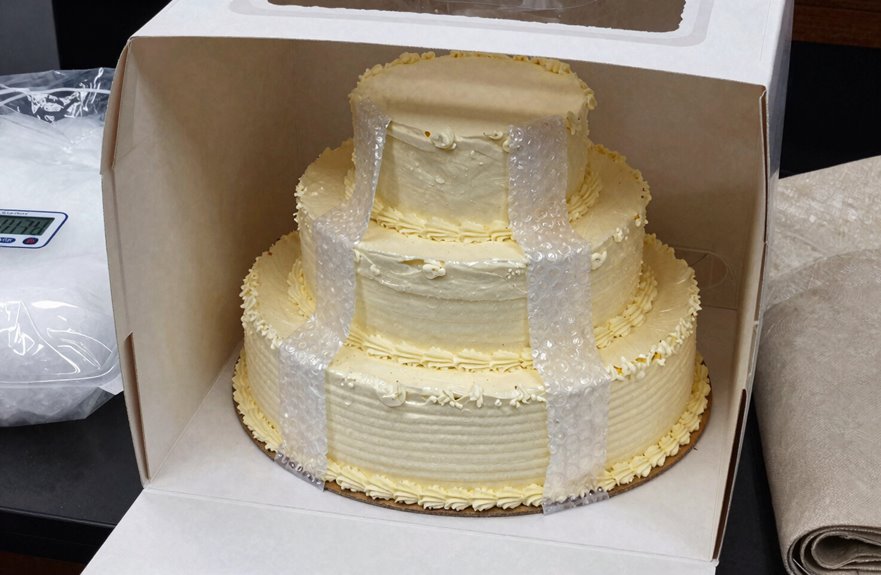
Which cakes emerge from cross-country travel not as crumbs but as celebrations? Dense, resilient treasures like pound cake, that buttery stalwart born to endure, are your best choice. You’re not shipping dreams here; you’re engineering edible architecture.
When you frost, freeze first, hardening icing into armor before wrapping your creation twice and tucking it into insulated packaging with cold packs that cradle like refrigerated wings. Jarred single-servings nest similarly, gel-packed and cool-headed through deserts or blizzards.
Brace boxes with two inches of cushioning, select bundts that hold their geometry, and reject fragile confections demanding immediate forks. This craft requires precision and passion, where technical mastery transforms into shared joy arriving intact, uncrumbled, and ready to celebrate.
Gather FDA-Approved Materials to Ship Cakes Safely
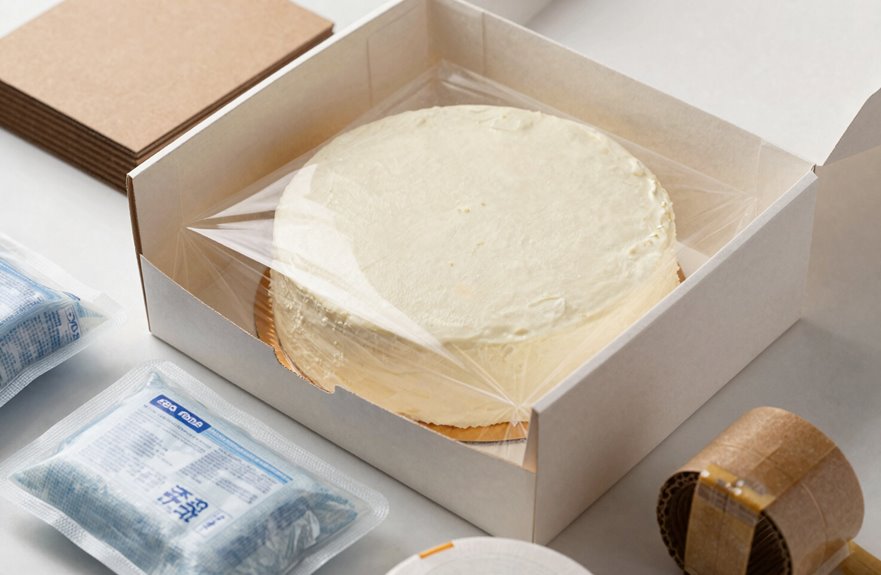
You’ll want to stock your kitchen with essential packaging supplies that meet strict food-safety standards. Start by selecting food-safe wrapping options. FDA-approved cellophane, parchment, and food-grade films protect your creation without leaching chemicals or absorbing moisture.
Add temperature control materials such as gel packs placed in strategic pockets and insulated liners that protect against heat exposure. Maintaining proper chilling for buttercream requires reliable thermal protection during shipment.
Essential Packaging Supplies
Every successful cake delivery begins with the right armor. You’ll gather FDA-approved materials starting with a sturdy custom cake box engineered to cradle your masterpiece like a vault protects treasure. Add rigid insulation lining every wall, creating a thermal cocoon that shields buttercream from summer heat or winter cold. Nestle gel packs strategically around your cake’s perimeter, ensuring fondant stays flawless across state lines. Choose food-safe cushioning over packing peanuts, wrapping your cake board snugly to eliminate shifting during transit. For heavier tiers, select 275# double-wall cartons; lighter creations ride safely in single-wall boxes. Add clear labels reading “PERISHABLE — REFRIGERATE UPON ARRIVAL” with handling directions. Proper packaging protects your cake’s quality and your reputation.
Food-Safe Wrapping Options
A cake’s journey from your kitchen to a distant celebration requires an invisible shield of protection, with that first delicate layer standing between your buttercream and the harsh realities of transit. You’ll want to reach for FDA-approved food-safe materials, such as plastic wrap or food-grade film, that seal in moisture and preserve every crumb of your creation. After cooling completely, nestle your cake onto a rigid board, then wrap it with two inches of cushioning using only food-safe padding that never compromises what touches the frosting. Skip the loose fill; instead, line your inner box to guard against packaging hazards. Shipping something perishable requires careful wrapping that demonstrates commitment to quality and craftsmanship.
Temperature Control Materials
Often, the difference between a cake that arrives pristine and one that surrenders to the whims of transit lies not in your decorating skill, but in your mastery of thermal defense. You’re joining a community of serious bakers who refuse to let weather dictate their success.
Select FDA-approved gel packs or phase-change packs as your allies, maintaining that precious core temperature through every mile. You’ll nestle cooling packs adjacent to, never touching, your creation. Barrier layers of food-safe film stand sentinel against condensation’s sneak attack. Hot days demand sturdy insulation paired with strategic cooling; cold snaps call for phase-change packs calibrated near 2°C, locked inside insulated shippers that buffer temperature swings like a skilled hand steadying a wobbling tier.
Schedule overnight shipping and coordinate with carriers to deliver not just cake, but the assurance that temperature fluctuations have been controlled throughout transit.
Freeze, Wrap, and Secure Cake to a Rigid Board
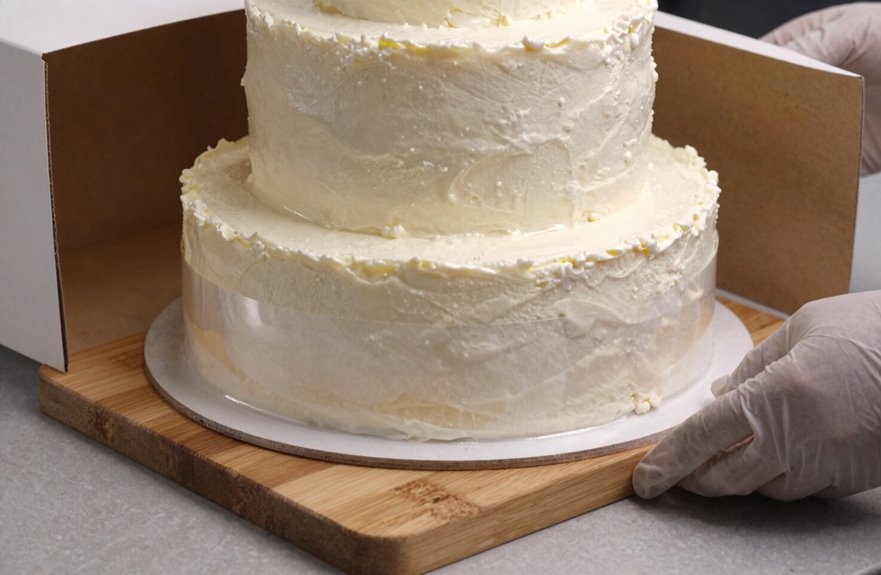
The foundation of any successful cake shipment rests upon a frozen, fortress-like base that transforms your delicate creation into a resilient traveler ready to weather the journey ahead. You’ll anchor your cake to a rigid board, creating an unshakable foundation that prevents the dreaded sidewall collapse everyone fears.
- Wrap your frozen cake in food-safe film, stretching it taut like a drumhead to eliminate air pockets and stabilize buttercream.
- Secure that wrapped masterpiece to your rigid board with a dab of royal icing, creating a strong bond.
- Nestle the board into a snug box, maintaining that critical two-inch buffer on all sides.
- Brace any wiggle room with food-safe cushioning, cradling your creation securely.
- Seal everything with packaging tape, eliminating loose-fill that can shift during transport.
Your cake arrives road-ready and intact.
Lock in Moisture With Food-Grade Barriers
Dry cake is the silent heartbreak of shipping, your masterpiece arriving as edible sawdust when moisture flees like water through open fingers.
You’re sealing fate with every layer of food-grade wrap, trapping hydration like a promise kept. First, cocoon your cake in film. Saran wrap clings tight, a second skin, before sliding it into moisture barriers: gallon bags or foil-wrapped fortresses that laugh at dry air. For icing protection, you need more than hope; you need strategy. Tuck bread slices nearby, humble moisture retainers sacrificing themselves so your buttercream survives. Balance is your craft. Pair these barriers with cool packs, lest condensation betrays you. Apply all moisture barriers before final sealing, guarding against contamination like a baker’s oath.
| Barrier Type | Function | Best For |
|---|---|---|
| Plastic wrap | Primary food-grade wrap | Direct cake contact, base layer |
| Foil + saran | Airtight moisture barriers | Heavy-duty moisture retention |
| Ziploc bags | Secondary sealing | Portable, reusable protection |
| Bread slices | Natural moisture retention | Extended transit, ambient temps |
| Gel packs + insulation | Temperature-moisture balance | Hot climates, preventing condensation |
Pad the Box So Your Cake Can’t Shift
You’ll want to master the art of immobilization, treating your cake like a precious cargo that refuses to budge by deploying a non-slip pad, perhaps a Silpat or textured silicone mat, as your foundation. Nestle your cake board so snugly against the box walls that sliding becomes impossible, like a puzzle piece finding its perfect home. Surround your creation with strategic cushioning, whether that’s bubble wrap, foam inserts, or rolled kitchen towels, creating a fortress that absorbs every jolt and turn the delivery route throws your way. When you seal that lid tight, you complete the assurance that your buttercream roses and fondant details will arrive exactly as intended, intact and in perfect condition.
Cushion Placement Strategy
A well-cushioned cake box protects your creation against the chaos of transit, transforming a simple cardboard container into a stable structure where your cake can withstand every bump and swerve.
Your cushioning strategy builds this protection layer by layer:
- Place a non-slip pad at the bottom, creating friction that anchors everything above
- Select a sturdy cake board extending beyond your cake’s diameter, forming a grip edge that cradles your work
- Pack food-safe cushioning two inches thick along every wall, absorbing vibrations like shock absorbers on a vehicle
- Deploy Silpat mats, silicone liners, or Velcro cargo blocks to keep tiers level and true
- Seal only after verifying centered placement with zero gaps. Proper spacing directly determines structural stability.
Movement Prevention Techniques
Securing your cake against the unpredictable rhythms of the road requires a deliberate system of restraints that transform your box into an immovable fortress. You’ll begin by laying a non-slip pad at the base, creating friction that grips your board like roots anchoring a tree. Select a larger cake board with a grip edge, giving your creation a stable stage that remains stationary through curves. For additional stabilization, press Silpat mats or Velcro cargo blocks into service as shock absorbers against jolts and jars. Surround your cake with cushioning on all sides, building walls of protection that absorb shocks from every direction. Finally, verify your boards fit snugly, lids close freely, and level stability is maintained. Your cake will arrive in optimal condition.
Pick a Double-Wall Box With Zero Wiggle Room
Once you’ve anchored your cake to its rigid board like a captain securing cargo before a storm, the vessel you choose becomes everything. Selecting a double-wall carton transforms that flimsy cardboard shell into fortress walls that refuse to bend, buckle, or betray your buttercream under pressure.
A double-wall carton transforms flimsy cardboard into fortress walls that refuse to bend, buckle, or betray your buttercream under pressure.
- Slide your wrapped cake, board and all, into that double-wall box like a puzzle piece finding its home.
- Build your cushioning fortress: two inches of food-safe foam, cradling every side with zero wiggle room for disaster.
- Brace the interior snugly, eliminating gaps where gravity might stage a coup.
- Line walls with EPS foam sleeves, creating insulating armor against the bumps of transit.
- Seal with strong tape, label “Fragile” and “Perishable,” and your bracing will hold the line.
Add Cold Packs and Weatherproofing for Your Route
Whether you’re sending a ganache-glazed masterpiece across sun-baked highways or a buttercream beauty through freezing December nights, your cake’s survival depends on mastering the cold chain effectively.
You’ll nestle gel packs around your creation, but never let them touch the sponge directly. Moisture degrades your crumb structure. Your insulated shipper becomes a fortress, locking in stability when external temperatures reach ninety degrees or drop below freezing. For cold weather shipping, tuck a fifteen-degree phase-change pack beside your layers to guard against the deep chill that turns buttercream brittle. When climate-controlled transport isn’t available, use overnight options and coordinate handoffs carefully. Label clearly, refrigerate immediately, and your cake arrives intact.
Seal and Label Your Package for Safe Handling
How do you ensure your cake survives the final gauntlet of conveyor belts, sorting facilities, and delivery trucks. You master the art of sealing and labeling, transforming your package into a fortress that protects itself when you cannot be present.
Your packaging becomes your communication method, and your labeling provides essential guidance. Consider these essential steps:
- Wrap your cake airtight, sealing every edge before cushioning, so no crumb escapes its sanctuary
- Select FDA-approved, food-safe materials for optimal protection during transit
- Mark “PERISHABLE — REFRIGERATE UPON ARRIVAL” clearly, guiding handlers toward proper care
- Affix fragile handling labels to every side of the package
- Verify every address twice, matching documentation precisely, so your cake reaches its intended destination
Ship Monday–Wednesday via Overnight Air
You’ll want to ship Monday through Wednesday via overnight air, treating these three days as your golden window where buttercream stability and mousse integrity depend on timely delivery. Pushing into Thursday risks your creation languishing in a weekend warehouse like a forgotten soufflé. By coordinating with carriers to bypass weekend hubs entirely, you build a bridge of continuous refrigeration that keeps ganache glossy and fruit fillings vibrant, transforming logistical timing into an act of culinary preservation. Prioritize this overnight commitment as your non-negotiable foundation. Compare rates across USPS, UPS, and FedEx not to cut corners but to find the sweet spot where speed meets sensible investment, ensuring your handcrafted layers arrive as impeccable as the moment you boxed them.
Optimal Shipping Window
- Select Monday–Wednesday departures to bypass weekend warehousing delays
- Demand next-day air service with climate-controlled cabins
- Negotiate narrow transit window guarantees with carriers experienced in perishables
- Prioritize temperature control protocols for buttercream and fruit-laden layers
- Secure overnight delivery to minimize distance-related deterioration
Speed and budget require constant balance. A compromised cake reflects poorly on your craft.
Weekend Avoidance Strategy
Why gamble with your buttercream’s fate when a simple calendar adjustment transforms shipping from nerve-wracking gamble into calculated triumph. You’ll ship Monday through Wednesday, harnessing next-day air to dodge weekend hubs where your masterpiece languishes in limbo, with temperature control compromised and ganache sweating through fondant.
| Ship Day | Arrival | Risk Level |
|---|---|---|
| Monday | Tuesday | Minimal weekend hub exposure |
| Tuesday | Wednesday | Balanced cost and speed |
| Wednesday | Thursday | Last safe window for freshness |
You’re orchestrating precision, not merely mailing dessert. Coordinate with your carrier and confirm your parcel never idles in unmonitored facilities. Align delivery with celebration dates. This strategy costs more, but it protects your reputation and ensures your mousse fillings arrive pristine with your client receiving a flawless confection.
Freshness Preservation Priority
How does a cake maintain its just-baked splendor when traversing hundreds of miles? Ship Monday through Wednesday via next-day air to minimize transit time and avoid weekend refrigeration issues.
- Pair your cake with ice packs nestled among cushioning layers
- Select next-day air to reduce exposure to temperature swings that threaten buttercream stability
- Invest in temperature-controlled shipping when fruit mousses or pastry cream fillings require extra protection
- Coordinate carrier timing with precision to maintain optimal freshness conditions
- Label prominently so handlers recognize they’re transporting someone’s celebration centerpiece
Overnight delivery wraps your creation in swift certainty, reducing spoilage risk significantly. Temperature-controlled shipping elevates this further, transforming logistics into active preservation that protects your handiwork. Your recipient unwraps not merely dessert, but the assurance that quality standards were maintained throughout transport.
Track Your Shipment and Verify Safe Arrival
Once your cake begins its journey, tracking becomes your most powerful tool for ensuring that buttercream roses and delicate fondant tiers arrive as intended, because every hour in transit matters when you’re balancing the structural integrity of a genoise sponge against the ticking clock of cream cheese fillings. You’re not merely watching dots move across a map. You’re guarding edible art.
Monitor your carrier’s tracking number consistently, refreshing as you await updates. Set alerts for delays, coordinate delivery timing to minimize transit exposure, and confirm your recipient’s availability so your creation never languishes on a doorstep. Request hold-for-pickup when possible, transforming uncertainty into controlled reunion. Upon arrival, inspect immediately for temperature control failures or tampering, documenting issues for your carrier. Your vigilance completes the craft.