

Your cakes rise through three interlocking forces. Chemical leaveners like baking powder or soda generate carbon dioxide bubbles, steam expansion occurs as water vaporizes past 212°F, and mechanical aeration develops through creaming butter with sugar or whipping eggs into protein-stabilized foams. These bubbles inflate in oven heat, growing like balloons until starch gelatinizes and proteins coagulate around 180°F, locking that height into permanent structure. This synchronized process transforms dense batter into cloud-like crumb.
How Cakes Rise: 3 Mechanisms Working Together
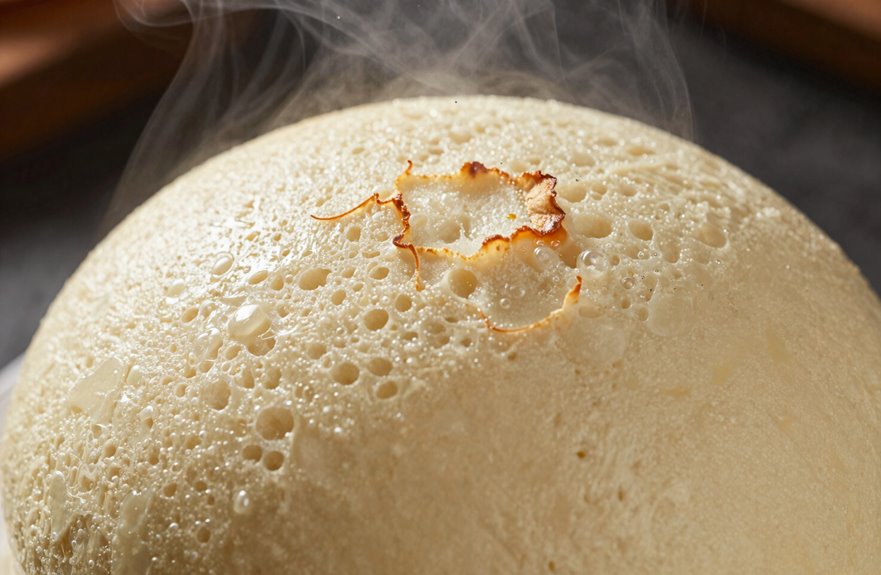
The rise of a cake isn’t magic, though it can feel that way when you pull a perfectly domed layer from your oven. It’s chemistry and physics working together in the heat. You’re orchestrating three simultaneous processes: gas leavening from leavening agents like baking soda and powder, steam expansion from moisture turning to vapor, and air bubble growth supported by fat and eggs.
Your batter becomes a temporary scaffold, with coagulating proteins and hydrated gluten holding the structure as temperatures climb. Around 140°F, water begins to turn to steam. By 212°F, that steam pushes outward with force. When these three mechanisms synchronize, you’ve captured lift itself. Imbalance reveals itself through doming or collapsing when structure sets too early or heat strays from the ideal range. Understanding this synchronization is what separates bakers who grasp the fundamentals from those who simply follow recipes.

Gluten Free, Vegan, Vegetarian, Kosher, Halal

One 8.1 ounce can of Double Acting Baking Powder

Double Acting Baking Powder
Baking Powder vs. Baking Soda for Cake Rise
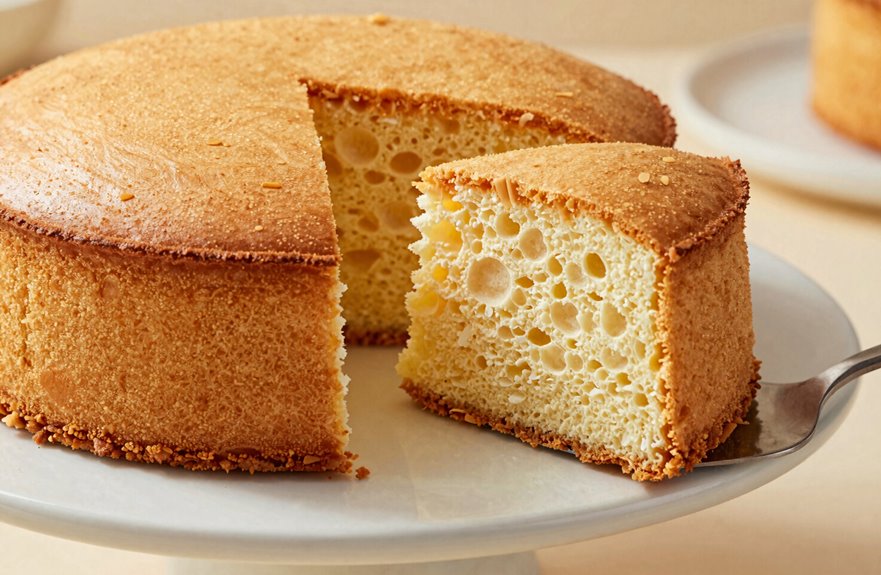
When choosing between these two leavening agents, you need to understand the chemical reactions where timing and ingredients must work together properly. Baking soda requires an acidic ingredient such as buttermilk, brown sugar, or natural cocoa to produce carbon dioxide, while baking powder comes complete with both acid and base already mixed together and ready to react with moisture and then again with oven heat. Single-acting powders release their bubbles all at once when the batter meets liquid, but double-acting varieties hold back some rising power for the heat of the oven. This delay gives you protection against a deflated crumb if your mixing takes longer than planned.

PURE BAKING POWER: Bob’s Red Mill Baking Soda ensures perfectly risen cookies, cakes, breads, and muffins that bring friends and family together

Extracted by a simple water process using no chemicals

100% Sodium Bicarbonate / It's just pure sodium bicarbonate with no additives and no fillers. Combine with citric acid to make your own fizzy bath bombs.
Chemical Reactions Compared
How exactly do you coax a cake skyward when you’re staring at two nearly identical white powders on your counter? You’re witnessing two distinct chemical performances, each with its own rhythm and requirements. When you add baking soda to your batter, you’re unleashing a single explosive reaction, a swift burst of carbon dioxide that demands immediate baking. Baking powder, conversely, operates like a two-act play you’ll orchestrate: moisture triggers the first rise, heat ignites the second. Both leavening agents create expanding gas bubbles, those precious cavities that transform dense batter into airy crumb. Like a conductor managing tempo, you’ll learn to match your powder to your recipe’s chemistry.
- Watch single-acting powders race against your oven timer, demanding swift hands
- Trust double-acting formulas to sustain your cake’s climb through baking’s heat
- Guard against expired powders that betray your efforts with flat defeat
- Balance quantities precisely, lest doming crowns your cake then caves
- Embrace the craft. Each bake teaches you this delicious science
Acid Requirements Differ
Understanding these chemical performances means recognizing what each leavener demands from your pantry. When you reach for baking soda, you’re committing to an acidic partnership. Your buttermilk, yogurt, or vinegar becomes essential chemistry, not mere flavor. Without this acid, your cake becomes dense and disappointing, with an unpleasant metallic taste. Baking powder carries its own acidic component, liberating you from that particular pantry hunt and requiring only moisture and heat to awaken its bubbling potential. You’ll notice baking soda works harder and faster, with roughly a quarter teaspoon per cup of flour against baking powder’s full teaspoon, its gas production a sprint rather than a relay. Your choice shapes the very architecture of your crumb. Mastering this distinction means understanding what your ingredients require for optimal results.
Heat Activation Timing
Once you’ve hydrated your batter and slid the pan into the oven, heat activation begins to unfold. This is where baking powder’s double-acting nature distinguishes itself from its single-acting counterpart. Baking powder releases CO₂ when wet, then again with heat, while baking soda demands acid and moisture for its reaction.
- You mix, you wait, you bake. Baking powder provides two rising phases.
- You forget the buttermilk, and baking soda leaves you with a flat result.
- You watch the oven window as the dough rises.
- You nail the timing, and steam joins the gas bubble expansion before structure sets.
- You master this process, and you’re orchestrating the structural integrity of your baked good.
How Steam Creates Invisible Lift in the Oven
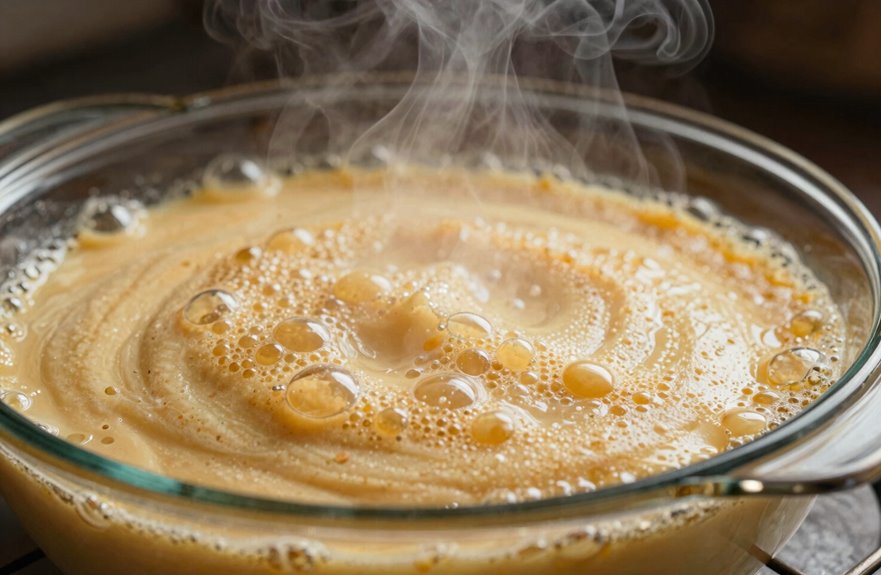
Why does a simple cake batter balloon into something airy and magnificent, defying gravity itself as it bakes? You’re witnessing the quiet alchemy of steam, that invisible architect of oven rise.
Steam starts its work around 140°F, when moisture from your eggs, milk, and butter awakens, then builds decisive pressure near 212°F. Water molecules transform from liquid to gas as they push against the tender walls of air bubbles, inflating them like microscopic balloons.
This internal pressure doesn’t act alone. It dances alongside any leavening gases already present, each force amplifying the other until your proteins coagulate and starches gelatinize, trapping that precious expansion in edible architecture. Your oven’s even heat becomes crucial here, for uneven temperatures cage steam or release it wildly, yielding sunken centers or cracked crowns instead of the tender, lofty crumb you’re striving toward.

The information below is per-pack only

Ingredients: Dextrose, modified corn starch, phosphate

PERFECT CONSISTENCY EVERY TIME: Elevate your desserts with our Whipped Cream Stabilizer, ensuring your creations hold their shape and texture. Ideal for chefs aiming for that exquisite, mouthwatering presentation.
How Creaming and Whipping Trap Air for Rise
When you cream butter with sugar, you’re not merely mixing ingredients. You’re shearing countless fat crystals against abrasive granules, coating each angular speck with lipid to form millions of microscopic air pockets that will inflate like hot-air balloons once the oven’s heat arrives. When you whip whole eggs or yolks with crystalline sucrose, you’re sculpting a protein-stabilized foam whose viscous matrix traps atmospheric gases in a resilient lattice, a technique that produces towering sponge cakes and ethereally light chiffons. You control this mechanical entrapment through deliberate choices: paddle attachments versus whisks, three minutes versus seven, cool butter versus properly softened. Each variable calibrates the density of your cellular structure, the very architecture of your rise. Master these three pillars of aeration, and you’ll transform from someone who follows recipes into someone who engineers desserts, bending physics to your will with nothing more than a mixer and informed intention.

Our Baking Powder Makes The Lightest, Fluffiest Cakes, Quick Breads And Baked Goods

Rumford Baking Powder in 4 oz can

The information below is per-pack only
Fat Crystal Aeration
The alchemy of fat crystal aeration begins the moment you press butter against sugar, transforming two humble ingredients into a scaffolding of microscopic air pockets that will ultimately determine your cake’s destiny.
- You feel the resistance change as crystals puncture fat, each grain becoming a nucleus for trapped breath.
- Your palms sense temperature’s critical role. Too warm, and the architecture collapses before baking begins.
- You discover rhythm in the paddle’s rotation, building structure through patience, not haste.
- You witness expansion as heat transforms imprisoned air into lifting force, gelatinizing the matrix around it.
- You balance on a knife’s edge between density and collapse, controlling air incorporation through speed and duration.
Master this technique, and you’ve developed the foundational skill that separates consistent results from unpredictable outcomes.
Egg Foam Incorporation
How does a liquid transform into a cloud that carries your cake toward greatness. You beat eggs, incorporating air that forms a stable air foam, reinforcing your batter’s architecture as heat builds. You’re crafting internal leavening centers, tiny balloons expanding with steam to push upward. Cream butter and sugar first, trapping fine bubbles that will join this aerial network. When you fold in whipped whites or cream, you’re layering lift upon lift, each gentle motion preserving what beating created. But beware: overmixing shatters your air foam, collapsing dreams into density. You’re not merely stirring; you’re building a community of bubbles that rise together, each depending on your patience and your respect for the delicate structure you’re creating.
Mechanical Air Entrapment
Why does a simple act of beating transform dense batter into something that defies gravity? You’re witnessing *air entrapment*, the invisible architecture that lifts your creations skyward. When you cream butter and sugar, you’re not merely mixing. You’re forcing thousands of microscopic air pockets into fat like a baker’s alveoli, each bubble a balloon waiting for heat’s command. Whip eggs, and you’ve built a protein-scaffolded foam, aerated infrastructure that swells with steam and expanding gas.
Your mastery of this technique connects you to centuries of craft. Watch for these critical moments:
- Butter lightens from golden to pale yellow, your visual cue of success
- Sugar crystals carve imperfections, rough edges that capture air like Velcro
- Egg whites climb from liquid to peaks, transforming through mechanical shear force
- Gentle folding preserves your bubble network, like handling living tissue
- Oven heat coagulates proteins, locking expanded structure before collapse
Don’t assault your batter with overzealous mixing; you’ll destroy your careful air entrapment and end with dense disappointment. You’re building edible skyscrapers, one stroke at a time.
How Heat Sets Cake Structure So It Doesn’t Collapse
What exactly transforms your liquid batter into a towering, tender crumb that holds its shape rather than sinking into itself like a failed soufflé? You witness heat performing its architectural magic, second by second. Around 140°F, water awakens into steam, pushing against walls that your baking powder and beating have already begun to inflate. Then starch granules gelatinize, swelling like tiny balloons, while gluten proteins coagulate into a viscoelastic network, an edible scaffolding that captures every precious bubble. By 180°F, this matrix strengthens and locks in height before gravity steals it. At boiling, steam surges one final time, and your cake solidifies into permanence. You’ve baked not just dessert, but structure itself, worthy of any table.

PURE BAKING SODA - 100% Sodium Bicarbonate

Pure Original Ingredients Baking Soda is the perfect kitchen staple

𝗣𝗨𝗥𝗘 & 𝗔𝗟𝗨𝗠𝗜𝗡𝗨𝗠-𝗙𝗥𝗘𝗘: Our aluminum free baking soda supplement is processed naturally through a clean, water-only method to preserve its purity. No chemicals ever. This organic baking soda aluminum free formula supports alkalinity, pH balance, and detox without harmful ingredients or heavy metals. It’s an aluminum-free baking soda designed for internal use and overall wellness, trusted for its clean sourcing, natural production, and uncompromising quality with zero additives or fillers.
How to Prevent Cake Doming
You’re ready to master the art of the flat-topped cake, that hallmark of professional baking you’ve admired in glossy magazines and upscale bakeries. Achieving this goal requires you to balance three interconnected factors: oven temperature control, which demands you calibrate with a reliable thermometer and sometimes drop the heat by ten degrees to slow that eager center rise; pan preparation methods, including the strategic wrapping of stripes or foil that insulate your edges like a cozy winter coat, equalizing the race between center and circumference; and batter distribution techniques, where you’ll learn to fill your pans with measured restraint and mix with gentle precision, avoiding the overdeveloped gluten that weakens your crumb and invites doming’s unwelcome hill. Each technique builds upon the last, transforming you from a hopeful home baker into someone who commands the chemistry of heat and moisture with consistency. Your cake will emerge level as a horizon.

Unit count type: Ounce
Oven Temperature Control
Most instances of cake doming, the frustrating peak that turns layer cakes into lopsided hills, trace back to a single hidden culprit behind your oven door. The relationship between displayed temperature and actual heat requires careful attention to master.
- Verify your oven temperature with a reliable thermometer, calibrating until display and reality match.
- Drop the heat by 10°F when doming occurs, letting gentler warmth promote even rise.
- Nestle pans on the middle rack, where heat circulates most effectively.
- Resist peeking for twenty minutes; your patience preserves the fragile structure developing within.
- Consider cake strips as thermal shock absorbers, slowing edge acceleration so centers catch up.
Pan Preparation Methods
The canvas upon which your cake rises deserves as much attention as the batter itself. A poorly prepared pan transforms even the most carefully crafted mixture into a domed disappointment. You must embrace the right pan dimensions. Small, deep vessels imprison your baking powder’s expansion, forcing upward eruption, while wide, shallow ones grant your leavening the freedom to spread evenly across the surface. Calibrate your oven with a thermometer to banish the treacherous hot spots that betray your baking soda’s steady work. Center your racks, rotate halfway through, and wrap cake strips around your pans like insulating armor to equalize heat so edges and centers set in harmony. You’ll avoid overfilling by leveling batter with precision, ensuring your chemical leaveners lift uniformly rather than crowning in rebellion.
Batter Distribution Techniques
How often does a promising cake develop a rounded crown when you want a level surface? Mastery comes through deliberate batter distribution techniques that control air bubbles and create even results.
Your tools in this craft include:
- Portion with precision, dividing batter equally and smoothing the surface like you’re frosting a canvas
- Select pans wisely. Wider, shallower vessels spread heat gently, while deep ones trap rise like pressure building in a kettle
- Mix with restraint, stopping when ingredients just combine to prevent trapped air bubbles from concentrating in the center
- Balance your leavening, using one teaspoon baking powder per cup flour as your baseline
- Bake with intention, preheating fully, rotating midway, and wrapping strips to equalize heat distribution
How to Fix a Dense, Flat Cake
Why does a cake sink in the middle like a deflated soufflé, leaving you with something closer to a pancake than a celebration centerpiece? This kitchen disappointment is common, but you can prevent it in your next bake.
First, examine your leavening agents. Baking powder and baking soda lose potency after six months, so test them in vinegar before risking another flat failure. Measure flour by weight, not volume, because excess flour creates a heavy, brick-like crumb that refuses to rise. When mixing, stop as soon as ingredients combine; overdeveloped gluten strands create density that no amount of additional effort can fix. Balance matters too. Excessive sugar or fat will sabotage your lift, so respect the ratios your recipe provides. Your next cake will stand tall and proud with proper technique.

Aluminum-Free Formula: Made without aluminum compounds, this baking powder provides a clean, pure leavening action that won't leave any metallic aftertaste in your baked goods, ensuring your recipes taste exactly as intended

Baking Powder

The information below is per-pack only
How Oven Temperature Controls Cake Rise
Where does the real magic of cake rise happen? Not in the mixing bowl, but in the controlled heat you’ve preheated. Here’s how oven temperature becomes your most powerful ally:
- Steam power: Your batter transforms when water hits 212°F, creating expanding vapor that lifts the crumb before proteins coagulate
- Even expansion: Calibrated heat prevents the dome effect; edges set like fortress walls while the center remains liquid
- Gentle patience: Lower, steady temperatures let you penetrate uniformly, yielding flat, stackable layers
- Verification matters: An oven thermometer reveals temperature inaccuracies; rotation conquers treacherous hotspots
- Material synergy: Judicious pan choices complement your thermal strategy
Master this variable, and you’ll bake with both scientific precision and intuitive understanding of how heat controls rise.

Natural and pure: Our baking soda is natural and pure with no additives or preservatives. Unscented and free-flowing, it's ideal for use in baking, cooking, cleaning and more

Includes 1.25 lbs. of Buttermilk powder in Reusable container for easy storage. Enhance your baked goods with added richness with this Premium buttermilk powder for baking! Made in USA.

Nature’s Sodium Bicarbonate Organic Use Aluminum Free Baking Soda. No Chemical Pure Baking Soda Powder For Health & Wellness. Sodium Bicarbonate 1lb
How Pan Size Changes Cake Height
You’ve mastered heat itself, now the vessel awaits your command. Your pan size shapes cake height as surely as oven temperature, transforming batter’s upward journey through spatial geometry. Choose shallow, wide vessels and watch your cake rise outward, settling into gentle tablelands rather than proud peaks. Conversely, deep narrow chambers force vertical growth, creating dramatic domed centers where batter, constrained by walls, climbs skyward like dough ascending a canyon. Too small, and overflow becomes your problem; too large, and your cake spreads thin, losing volume and structure. You’re seeking that Goldilocks moment where capacity meets volume, where heat kisses every surface evenly. Match your batter to your vessel’s capacity following recipe guidance, and you’ll craft cakes that rise with uniform height, properly proportioned to the pan dimensions.
Ingredient Ratios for Maximum Cake Rise
How precisely do you measure the invisible architecture that transforms humble batter into towering celebration. You begin with leavening agents, the yeast of your chemical dreams, where one teaspoon baking powder per cup flour sets your foundation, or a quarter teaspoon baking soda paired with buttermilk’s acidic kiss. Your pantry holds secrets, and freshness determines destiny. Stale powders betray you with flat, mournful crumb.
Consider these pillars of your rising empire:
- Fresh leavening agents, your invisible allies
- Flour structure balanced against sugar’s tender weight
- Fat measured to enrich without suffocating lift
- Acidic companions awakening dormant soda
- Batter harmony, where each element bows to the others
Precision in baking is not constraint but liberation. Each ratio is a promise of altitude achieved through respect for chemistry’s quiet laws.

Imported straight from France Great baking powder to bake cakes Single-acting baking powder Made by Alsa since 1897
Mixing Mistakes That Flatten Cakes
Overmixing develops gluten like rope pulling tight, trapping air that balloons and collapses, leaving your cake’s heart hollow. Cream butter and sugar with measured breath, not wild abandon, lest you whip in excessive air that bursts in the oven’s heat. Balance your leavening agents, baking powder or baking soda, within batter mixed to satin uniformity, or density pockets rise like islands in a storm, flattening your creation’s crown. Technique determines whether your cake rises properly or falls flat.
Your Complete Cake Rise Checklist
Where precisely does your next great cake begin its ascent? It starts with mastering the invisible architecture of leavening agents, those chemical allies that transform dense batter into cloud-like structure.
- Measure your leavening agents with precision, balancing about one teaspoon baking powder per cup of flour for symmetrical crowns rather than volcanic domes
- Embrace the double lift: baking powder’s initial room-temperature activation plus its oven heat surge, creating bubbles that expand like rising bread
- Fold, don’t punish. Overmixing develops gluten that traps air unevenly, sentencing your cake to tunnel-riddled collapse
- Control your heat stage, starting around 325°F so steam and leavening gases expand gradually, coaxed rather than shocked into action
- Balance acid and base when using baking soda. Chemistry rewards this precision with perfect rise