
You’ll need a 10-inch and 8-inch tiered combination to elegantly serve 50 people, yielding 48–62 wedding-style portions through proportional stacking that creates visual drama while maximizing your yield. This pairing delivers the stepped silhouette that transforms your cake into edible architecture, with the broader base anchoring the composition while the narrower crown draws the eye upward. If your gathering trends smaller, an 8-inch and 6-inch pairing serves 40–45, though you’ll want to supplement with a kitchen cake or adjusted cutting. Single-tier alternatives exist: a 12-inch round or 11×15 sheet reaches 50, but sacrifice that centerpiece presence guests remember. Square shapes maximize efficiency through grid cutting, while rounds favor elegance with curved wedges. The path you choose shapes both portion and perception, and the following sections detail how each decision affects your celebration.
Calculate Guest Count and Dessert Goals for 50 People
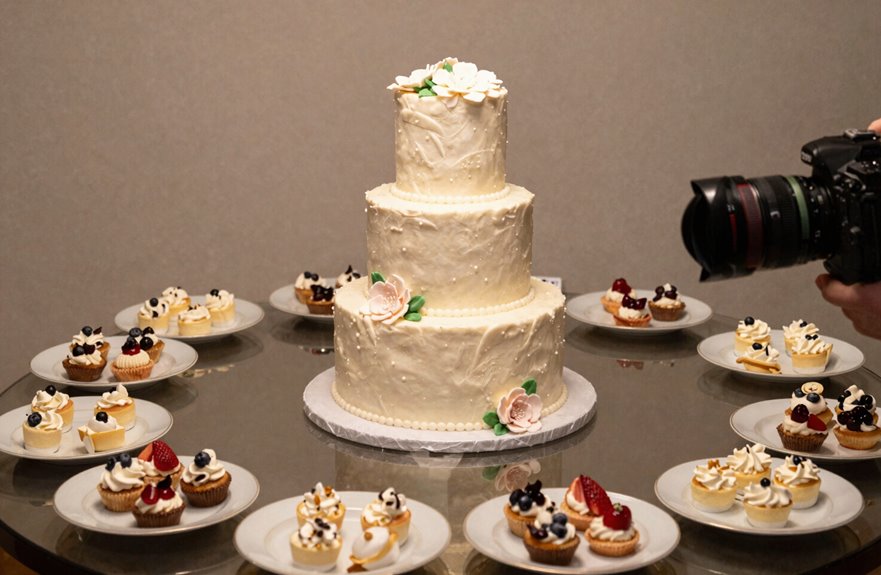
Determining the right cake size for fifty guests requires straightforward arithmetic and a clear vision of your event’s sweet finale. You’re counting heads while orchestrating a shared experience where every guest feels included in your celebration’s sweetness.
Start by deciding if cake stands alone or shares the spotlight with other desserts, since this choice directly shapes your tiered-cake-size strategy. For fifty attendees seeking togetherness around a central, impressive dessert, you’ll want approximately fifty to sixty servings as your target. Generous slices for family-style gatherings differ from elegant, wedding-style portions.
Your dessert goals become the compass guiding every subsequent decision, ensuring no one watches empty-handed while others indulge.
Two-Tier Combinations: The Best Cake Sizes for 50-60 Servings
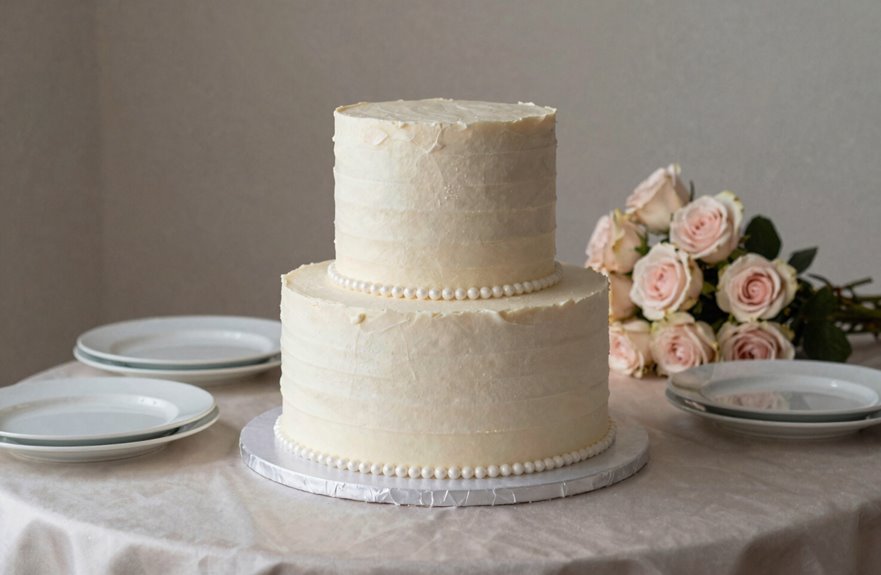
You’ll find that a two-tier cake strikes the perfect balance between visual drama and practical portioning. When you’re crafting a celebration centerpiece for your community, the right tier pairing ensures everyone feels included without leaving you with excessive leftovers.
For reaching that 50–60 serving target, you’ll want the 10-inch and 8-inch combination, which delivers approximately 48–62 portions depending on your slicing technique. The 8-inch plus 6-inch pairing offers elegance but yields only roughly 38–46 servings, falling short of your gathering’s needs. You’re seeking that stepped silhouette where the upper tier narrows gracefully, creating architectural harmony. Your two-tier creation becomes more than dessert; it signals that every guest belongs at your table.
Why 10-Inch and 8-Inch Tiers Give You 50-60 Servings
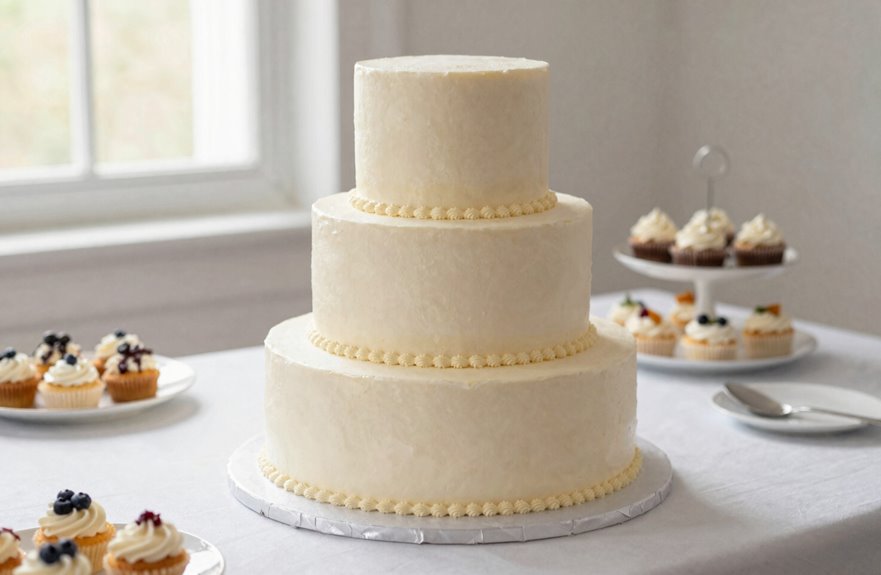
You’ll find that a 10-inch tier yields roughly 36 wedding-style servings while its 8-inch companion adds another 24, bringing your total to that sweet spot of 50–60 portions without any guesswork. This pairing creates visual harmony where the broader base anchors the design like a sturdy foundation beneath a graceful spire, giving you that coveted silhouette bakers call “proportional elegance.” When you stack these tiers, you’re feeding a crowd while crafting a centerpiece that balances generosity with refinement. Practical math and artistic vision work together in this configuration.
Serving Count Breakdown
How does a simple pair of numbers transform into a celebration centerpiece that feeds a crowd? Stack a 10-inch tier atop an 8-inch tier, and you get roughly sixty servings that welcome every guest to your table. The larger base contributes about thirty-six cake portions, while the crown adds twenty-four more, creating a foundation of abundance for your gathering. Your serving sizes shift based on cutting style; generous wedding-style cuts, those elegant 2-by-1-inch rectangles, bring you closer to fifty portions, while modest finger-sized slices stretch your bounty beyond sixty. An 8-inch paired with a 6-inch offers merely forty to forty-five servings, leaving some guests without cake. Select the right configuration, and your cake becomes both sustenance and symbol, an edible architecture of inclusion.
Visual Proportion Balance
Selecting a cake configuration that satisfies both eye and appetite requires attention to the mathematics of proportion, where diameter and height create visual relationships through geometry. Pairing a 10-inch tier with an 8-inch tier creates a silhouette that feels harmonious, like a dancer poised on pointe; slender at the peak, grounded below.
This combination delivers 50-60 servings through calculated overlap: the broader base yields 28-38 portions, while the crown adds 24-28 more, depending on your cutting style. The proportions matter because your guests eat with their eyes first. A 10-inch over 8-inch stack maintains that coveted 1.25:1 width ratio, avoiding the squat appearance of an 8-inch over 6-inch pairing, which sacrifices both visual grace and adequate servings. You’re crafting edible architecture, after all.
When 8-Inch and 6-Inch Tiers Work Instead
You might consider an 8-inch and 6-inch two-tier pairing when your guest list hovers closer to 40–45 people, or when you’re aiming for that delicate, elongated silhouette where the narrower top tier creates visual harmony like a dancer’s poised arabesque. While this combination demands strategic portioning through slender wedding slices or petite dessert squares to stretch toward 50 servings, you’ll find the proportional balance strikes a refined aesthetic that bulkier tiers simply cannot achieve. If your heart’s set on this elegant architecture for a larger crowd, you can bolster your numbers by keeping a discreet sheet cake in the kitchen, ensuring every guest receives their sweet moment without compromising the cake’s graceful stance.
Serving Count Feasibility
Whether you’re working within a tight budget or simply prefer the elegance of a more intimate tiered display, an 8-inch and 6-inch combination can satisfy your guest list, provided you’re willing to adjust your serving strategy. This pairing yields 40–45 standard wedding slices, slightly under your goal, yet with portion adjustments you can reach your target.
Consider this roadmap to your target:
| Adjustment Technique | Expected Yield Boost |
|---|---|
| Slice 1.5″ × 3″ instead of 1″ × 2″ | Brings serving count to 50–55 |
| Add petite sheet cake (kitchen cake) | Seamlessly extends capacity without disrupting display |
| Serve additional dessert station | Reduces pressure on cake sizes alone |
This tiered duo provides practical solutions for resourceful bakers who need flexibility in their serving options.
Visual Proportion Balance
How does a cake command the room without overpowering it? You achieve this through careful cake sizes selection that honors both aesthetics and appetite. The 8-inch and 6-inch pairing creates a graceful pyramidal silhouette, its proportions echoing classical architecture rather than clunky mass. You’re steering clear of the awkward 8-inch and 4-inch combination, which visually stumbles like a sentence with no conclusion. Consulting your serving chart, you’ll find this duo yields 40–50 standard portions, stretching to 50–60 with generous cuts, precisely your target. The narrower top tier maintains that coveted proportional ratio, drawing eyes upward in elegant ascent. When you calculate precise yields (24 servings from your base, 12–18 from above), you’re not merely baking; you’re sculpting edible geometry that welcomes every guest without waste.
Single-Tier Options: Can One Cake Feed 50 People?
Exactly how ambitious can your single-tier vision become when fifty hungry guests are waiting. You can reach your goal with one beautifully executed layer. A 12-inch round cake typically yields 50–60 servings, giving you that gathered-around-one-table feeling. Alternatively, an 11×15-inch sheet cake, when cut in neat columns and rows, stretches generously to feed your crowd. If you’re drawn to tiered-cake sizes but want simplicity, a 7-inch stacked atop a 10-inch creates visual drama without complexity, though this technically crosses into two-tier territory. Your single-tier option remains attainable through precise portioning, where even, disciplined knife work transforms one cake into abundant servings.
| Approach | Dimensions | Typical Yield |
|---|---|---|
| Classic Round | 12″ diameter | 50–60 servings |
| Sheet Style | 11″ × 15″ | 50–55 servings |
| Compact Round | 10″ diameter | 38 servings |
| Expansion Combo | 7″ + 10″ tiers | 50+ servings |
Birthday vs. Wedding: How Cutting Style Affects Your Servings
Why does a cake that feeds thirty-eight at a birthday party suddenly stretch to forty-five at a wedding? Cutting style determines your results. Wedding slices, those elegant 1-inch fingers, multiply your cake servings while birthday wedges satisfy hearty appetites.
One cake, two counts: slice thin for crowds, thick for hungry guests.
Consider these essentials when planning your celebration:
- Match portion to purpose – grand dessert tables welcome modest slices, while solo cakes demand generosity
- Embrace the tiered approach – stacked creations offer visual drama and practical portion flexibility
- Calculate your crowd’s expectations – hungry dancers need more than polite reception nibblers
Cutting style directly impacts how many guests you can serve and reduces leftover waste.
Round, Square, or Sheet: Which Shape Serves More?
When you’re deciding between round, square, or sheet configurations for your fifty-guest celebration, you’ll want to weigh how shape serving comparisons and cutting efficiency factors directly impact your bottom line. Square tiers, with their crisp corners and maximized surface area, typically yield more portions than their round counterparts of identical diameter because you avoid wasting the curved-edge triangles that often crumble or shrink during portioning. A 9-inch square cake eclipses a 9-inch round in total servings; this geometric advantage compounds when you stack multiple tiers. Understanding this spatial relationship reduces ingredient waste and labor costs while ensuring every guest receives a full slice without shortage.
Shape Serving Comparisons
How differently does geometry shape your guests’ satisfaction when you’re planning for fifty hungry celebrants? When you’re planning cake servings for your community, understanding square vs round configurations transforms your approach from guesswork into confident hospitality.
You’ll notice three distinct advantages:
- Square cakes maximize yield, delivering more uniform portions through grid-pattern cutting that wastes less surface area
- Round cakes create elegant presentation, though you’ll sacrifice approximately 15% in serving capacity compared to square alternatives of identical diameter
- Sheet cakes dominate efficiency, offering the cleanest 2×2 inch portions with minimal trim loss and straightforward execution
For your fifty-person milestone, consider how an 8″ / 6″ tiered pairing leverages these geometric truths. Square foundations provide your numerical safety net, while rounded elegance graces your celebration’s crown. The mathematics of cake geometry directly determines portion consistency and guest satisfaction.
Cutting Efficiency Factors
You’ve mastered the geometry of cake silhouettes, and now the blade becomes your instrument for realizing every last serving from that carefully chosen form. Your cutting efficiency depends entirely on how you translate shape into portions, where square and sheet cakes become your allies against waste, their straight edges yielding clean 2×2 or 2×3 inch blocks while round cakes demand curved compromises that sacrifice precious crumbs to the circumferential void.
| Shape | Cutting Pattern | Typical Servings |
|---|---|---|
| Round | Curved wedges | 28–38 (birthday) |
| Square | Straight grid | 35–45 (wedding) |
| Sheet | Linear rows | 50–60 (efficient) |
You’ll find your rhythm through practice. Each confident stroke transforms cake architecture into shared celebration, with your knife serving as the bridge between mathematical precision and communal joy.
Need More Servings? Add a Kitchen Cake to Your Order
Why settle for a smaller display cake when your guest list swells beyond a tiered cake’s yield? You’ve crafted this beautiful 10″ and 8″ centerpiece, yet your servings fall short. A kitchen cake solves this problem by providing additional slices prepared behind the scenes.
Here’s your path to abundance:
- Order a simple sheet cake in matching flavor, frosted plainly to slice behind the scenes
- Request your baker coordinate the kitchen cake’s crumb and filling with your tiered star
- Serve display cake first, then bring out kitchen cake slices as your encore
This approach ensures every guest receives a slice while keeping your tiered cake intact as the visual centerpiece throughout the celebration.
Adjust Cake Servings for Kids, Staff, and Leftovers
A kitchen cake fills your numbers gap, but numbers alone won’t guarantee the right cake experience for everyone holding a fork. When you’re planning for mixed company, serving adjustments become essential for hospitality that feels inclusive rather than institutional.
Count your youngest guests as half to two-thirds portions, since small hands require smaller servings. Your hardworking staff deserves recognition through their own slices, though these may be modest like the children’s portions. These calculated cake servings ensure fair distribution among all attendees.
Plan for leftovers by rounding up your order and including extra servings in your total. Additional cake provides real benefits: second helpings for interested guests, staff members taking home portions, or simply having enough supply to avoid running short. You’re building more than dessert; you’re creating an inclusive gathering through thoughtful planning.
Your 50-Person Cake Order Checklist
How do you transform scattered decisions into a cake that arrives exactly as you’ve envisioned it? This checklist ensures your tiered cake sizing aligns with your celebration’s needs.
- Select your foundation: Choose between 10″ & 8″ or 8″ & 6″ tiers, knowing both yield 50–60 cake servings depending on your cutting pattern.
- Balance your silhouette: Ensure your top tier stays narrow and proportionally smaller, avoiding the awkward 8″ & 4″ pairing that disrupts visual harmony.
- Define your portions: Clarify whether you’re serving wedding-style slivers or generous birthday wedges, as this transforms your yield entirely.
Once you’ve completed these steps, confirm your tiered cake sizing, finalize pricing, and schedule delivery.